The Floor Was Clean. Why Was the Cleaning Shift Still Running?
What dish soap, low-foam detergent, and floor scrubber tank size really mean for a busy facility
A self-propelled scrubber does more than move across the floor. Its water supply, recovery system, and route all affect how much work fits into a shift.
Imagine a warehouse closing for the evening. The scrubber has made its final pass. The floor looks better. But the cleaner is still working.
There is a slippery patch to rinse. The recovery tank needs attention. Then comes another trip to the utility room for fresh water before finishing the last aisle.
The manager has been asking the wrong question: “How fast can this machine scrub?”
A better question is: “How much of the shift does the machine spend actually cleaning?”
The answer depends on more than the brush, the battery, or the number printed next to “square feet per hour.” It depends on what goes into the solution tank, what comes back through the squeegee, and how often the operator has to leave the route.
First, the soap problem: cleaning harder can make recovery harder
There is a reason people search for whether they can clean floors with Dawn dish soap. Dish soap removes grease in a kitchen. It is inexpensive and familiar. Why not pour some into a commercial scrubber?
Because cleaning a plate and recovering dirty water through a vacuum system are different jobs.
Automatic floor scrubbers can use cleaning chemicals—including AIOLITH's commercial machines—but they need a compatible, low-foam detergent intended for automatic scrubbers and suitable for the floor finish. Household dish soap is usually designed to make suds. In a scrubber, excess foam can interfere with recovery and, if it reaches the vacuum system, contribute to motor damage.
More detergent is not automatically more cleaning. Overdosing may leave a film, create extra rinsing work, and turn a one-pass job into a two-pass job.
The useful rule is simple: Use the right chemistry at the label's dilution, not the most soap you can see. Also match the brush or pad to the floor and soil. A greasy shop floor and a finished retail floor do not necessarily need the same setup.
For the household question itself, see AIOLITH's existing guide, Can You Use Dawn Dish Soap to Scrub Floors?. This article addresses what happens after you choose a professional cleaning process.
The part nobody puts in the productivity headline
Think of a cleaning shift as three linked jobs:
- Scrub: put an appropriate amount of solution on the floor and agitate the soil.
- Recover: collect the dirty solution through the squeegee and vacuum into the recovery tank.
- Keep moving: refill, empty, turn, and travel between zones with as few avoidable interruptions as practical.
A machine that is fast at Step 1 can still be slow at completing the route if Step 2 leaves streaks or Step 3 sends the operator back to a distant utility closet.

That is why both tanks matter. The solution tank carries clean water and diluted detergent. The recovery tank holds the dirty liquid collected from the floor. When either becomes a constraint, the operator may need to stop—even if the battery has plenty of charge left.
The memorable distinction: tank capacity is not cleaning speed. It is one limit on uninterrupted cleaning time.
What a larger tank can change: AF2217 in context
The AIOLITH AF2217 self-propelled floor scrubber has a 16-gallon solution tank and a 17-gallon recovery tank, paired with a 22-inch cleaning path and powered traction for longer routes.
For perspective, Tennant lists the T300 with an 11-gallon solution tank and 14-gallon recovery tank. The Advance SC450 is listed with 10.5 and 11.9 gallons, respectively. These are selected walk-behind machines, not identical configurations, and their water-management technologies and other features differ. The takeaway is not that a bigger tank always wins. It is that the AF2217 gives a facility more onboard water capacity to plan around.
| Walk-behind model | Solution tank | Recovery tank |
|---|---|---|
| AIOLITH AF2217 | 16 gal | 17 gal |
| Tennant T300 | 11 gal | 14 gal |
| Advance SC450 | 10.5 gal | 11.9 gal |
If two machines are operated at a similar actual solution-flow rate, the larger solution tank has the potential to run longer between fills. But the real outcome also depends on soil load, flow setting, foam, how much dirty water is picked up, tank shutoff, and how far the refill station is from the work area. Tank size alone cannot establish a minutes-saved claim.
There is a second advantage worth considering. On a longer route, the AF2217's self-propelled drive reduces the need for the operator to push the full machine weight. That helps address operator effort, while the tanks address a different interruption: leaving the route for water.
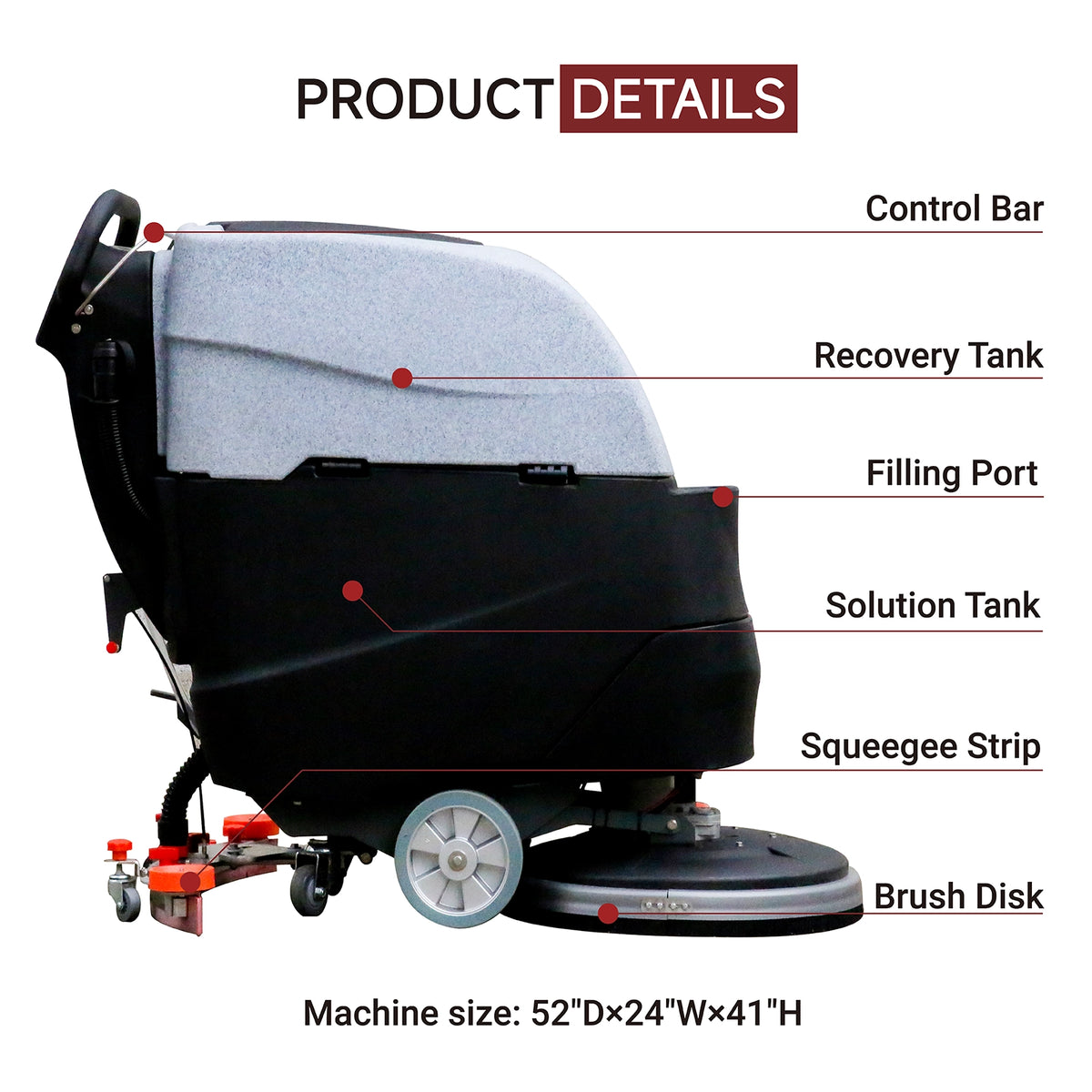
The clean-water tank and recovery tank serve different purposes. Check both when planning a long route.
See the AF2217 scrub and recover water
AIOLITH's AF2217 in operation. The footage shows scrubbing and water pickup; it is not a test of refill frequency or route time. Watch on YouTube.
A five-minute route test before buying any floor scrubber
Instead of choosing only by advertised coverage, walk your facility's intended cleaning path once. Note:
- The floor and soil: Is the task ordinary dust and footprints, grease, or stubborn tire marks? Which pad and low-foam detergent are suitable for that floor finish?
- The real route: How many tight turns, aisles, doors, and obstacles interrupt straight-line cleaning?
- The water stops: Where can the operator refill clean water and legally empty recovered dirty water? How long is the round trip?
- The recovery result: Does the squeegee leave water behind? If so, inspect the blades, debris, alignment, and cleaning chemistry before assuming you need more passes.
- The operator: Will someone push the machine for the whole route, or would powered traction reduce fatigue?
This test also prevents an expensive mistake: buying a machine with a very large tank that is too wide to navigate the facility's narrowest passage. Measure the full machine and squeegee width, not just the brush path.
A simpler way to remember the buying decision
Clean chemistry. Clean pickup. Fewer detours.
Those three things are easier for a cleaning crew to manage than a headline productivity figure that assumes uninterrupted straight-line travel.
A small facility with nearby water access may not need the largest tank. A larger warehouse with distant service points may value onboard water and self-propelled movement much more. Both decisions can be right.
If your current scrubber keeps leaving the route for water—or if you're comparing an 11-gallon machine with a 16-gallon option—review the AF2217's specifications, dimensions, and service support. Bring your cleaning area, floor type, refill location, and required route time. Those details tell you more about fit than square footage alone.
Follow Aiolith on Google
Get more industrial cleaning guides and equipment insights from Aiolith.
