
5 Ways CO₂ Cleaning Can Support Food & Beverage Equipment Cleaning

Where CO₂ Cleaning Fits in Food and Beverage Facilities
Dry ice blasting can remove compatible grease, baked-on product residue, adhesive, carbon, and packaging buildup from selected equipment surfaces. The dry ice media sublimates after impact, which can make the process useful where adding wash water or spent abrasive media is undesirable.
Important: dry ice blasting is a cleaning method. It does not automatically sanitize, disinfect, sterilize, validate allergen removal, or make a process FDA, USDA, HACCP, or NSF compliant. Food-contact use must be evaluated under the facility’s sanitation plan, equipment-manufacturer instructions, and applicable operating procedures.
1. Clean Selected Residue Without Adding Process Water
The blasting stream does not add liquid water, and the dry ice particles convert to gas after impact. This can help when water intrusion, drying time, or wastewater from the blasting media would create a maintenance problem.
It should not be described as universally “waterless” or “chemical-free” at the facility level. A food plant may still require detergents, rinsing, sanitizers, verification, and other sanitation steps before equipment returns to production.
2. Avoid Spent Blasting Media—Not All Secondary Waste
Dry ice does not leave sand, glass bead, or other spent blasting media behind. However, the removed fat, protein, sugar, ink, adhesive, coating, dust, and other contamination still remain and may be dispersed by the air stream.
Facilities need a plan for containment, collection, ventilation, and disposal. The method should not be promoted as producing “zero secondary waste.”
3. Reach Selected Equipment Areas After Safe Shutdown
Dry ice blasting may help clean accessible conveyor components, molds, tooling, frames, guards, packaging equipment, adhesive systems, and other approved surfaces. It can sometimes reduce manual scraping or disassembly after the process has been tested.
That does not mean every conveyor, mixer, slicer, filler, seal head, sensor, belt, seal, bearing, coating, or electrical component is compatible. Follow the equipment manufacturer’s service instructions, place machinery in the required safe condition, and test a representative area before expanding the process.
4. Support Pre-Cleaning Before Sanitation and Verification
Removing heavy soil can support the later sanitation process by exposing surfaces that were covered by residue. In a validated program, dry ice blasting may serve as one mechanical cleaning step before inspection, allergen-control verification, sanitizing, or other required procedures.
The visible removal of residue is not proof that microorganisms or allergens have been reduced to the facility’s required level. Verification methods, contact times, chemical labels, sampling plans, and sanitation records remain separate responsibilities.
5. Reduce Cleaning Time Only When the Actual Workflow Supports It
Dry ice blasting can reduce manual wiping, scraping, washing, drying, or disassembly in the right application. There is no universal three-times-faster result, fixed percentage reduction in CO₂ use, or guaranteed downtime saving.
Compare the complete current and proposed workflows, including shutdown, lockout, setup, disassembly, cleaning, dry ice handling, compressed air, containment, inspection, sanitation, and return-to-service checks. Any productivity claim should come from a timed trial on the actual equipment and residue.
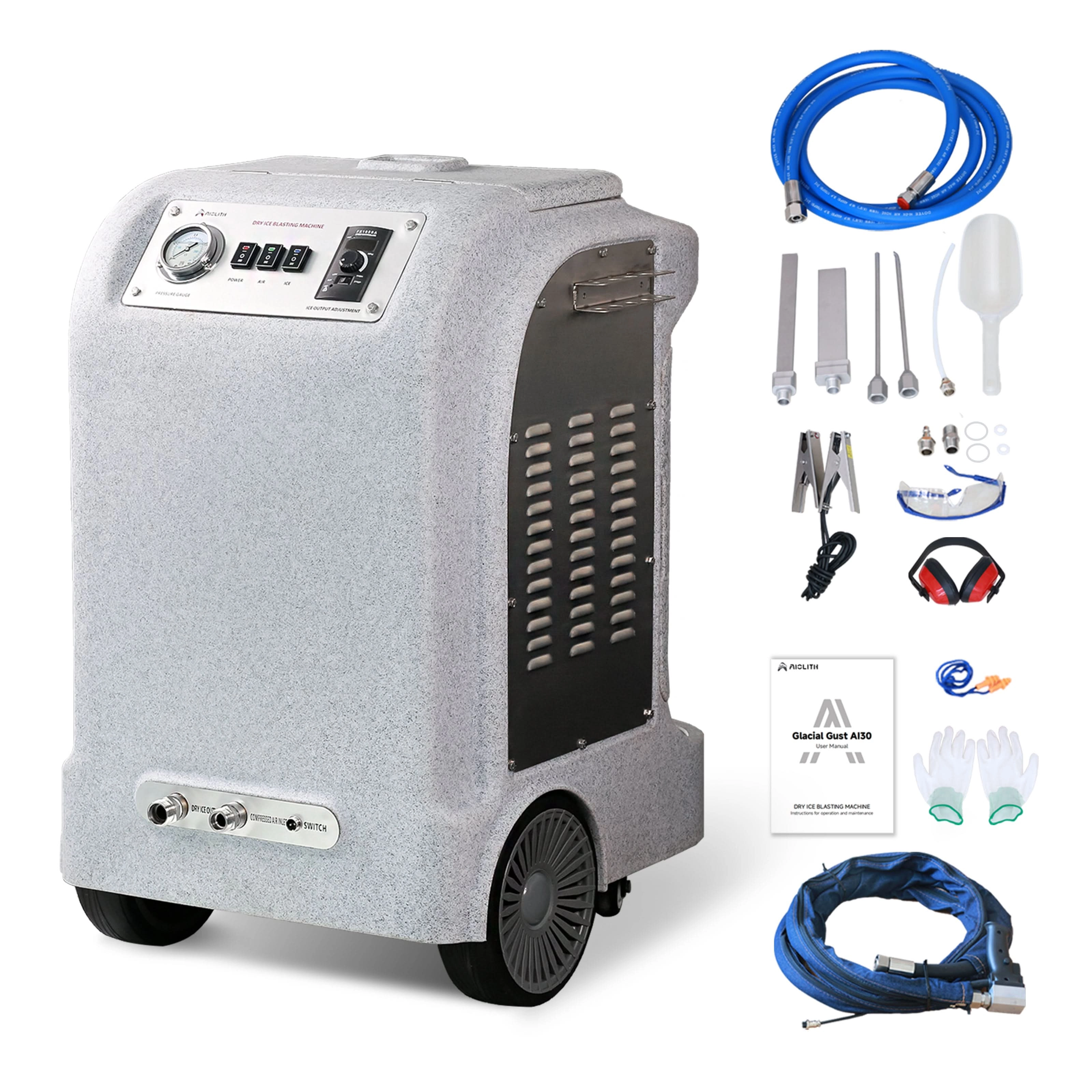
AI30 Dry Ice Blaster
Portable dry ice blasting for compatible maintenance-cleaning applications.
AI30 as a Technical Example
The AIOLITH AI30 can be considered for compatible light-to-medium maintenance cleaning after the application has been reviewed.
- Voltage / frequency: 110V / 60Hz
- Hopper capacity: 44 lb
- Dry ice size: 3 mm or smaller
- Dry ice output: 0.66–1.32 lb/min
- Working pressure: 87–116 PSI
- Machine air demand: 71–141 CFM
Compressor compatibility must be checked by sustained CFM at the required PSI. Use clean, dry compressed air and confirm any additional air-quality requirements established by the facility. The AI30 should not be described as HACCP compliant, NSF certified, allergen-free, capable of eight continuous hours, or universally approved for food-contact equipment unless documentation for that exact claim is available.
Implementation Checklist
- Identify the exact equipment component, substrate, coating, and residue.
- Confirm manufacturer approval and the required shutdown or hazardous-energy controls.
- Test the selected pressure, airflow, feed rate, nozzle, distance, and angle on a representative area.
- Confirm dry ice pellet size, freshness, storage, and supply timing.
- Provide adequate ventilation and evaluate carbon dioxide exposure.
- Control noise, cold-contact hazards, flying debris, and required PPE.
- Contain and collect removed contamination.
- Inspect the equipment and complete all required sanitation and verification steps before production resumes.
Cost and ROI Must Be Measured
Do not assume a fixed eight-to-fourteen-month payback, a seven-to-ten-year machine life, or a universal percentage reduction in labor, water, chemicals, maintenance, or equipment wear.
A useful comparison includes current cleaning labor, downtime, disassembly, water, chemicals, drying, waste handling, dry ice, compressed-air energy, ventilation, operator training, maintenance, and equipment cost. Use a representative trial to establish the facility’s own numbers.
Conclusion
CO₂ cleaning can support selected food and beverage equipment-cleaning tasks when the surface, residue, machine, safety controls, and sanitation program are compatible. Its strongest advantages are the absence of added process water and spent blasting media—not guaranteed sanitation, allergen removal, compliance, or cost savings.
Follow Aiolith on Google
Get more industrial cleaning guides and equipment insights from Aiolith.
