
Is a Dry Ice Cleaner the Smarter Solution in 2026?
 The Global Shift Toward Dry Ice Cleaner Technology
We are witnessing a clear transformation in industrial cleaning.
Traditional methods struggle with efficiency, safety, and sustainability.
As a result, dry ice cleaner technology continues gaining momentum worldwide.
According to a 2024 report by MarketsandMarkets, the industrial cleaning equipment market is growing at over 7% annually.
Dry ice cleaning represents one of the fastest-growing segments.
This growth comes from manufacturing, food processing, aerospace, and automotive industries.
Unlike chemical or abrasive methods, a dry ice cleaner removes contaminants without water, chemicals, or secondary waste.
Therefore, production downtime decreases significantly.
At the same time, equipment lifespan increases.
Why Traditional Cleaning Methods No Longer Meet Industrial Demands
We often see factories relying on solvents, sandblasting, or pressure washing.
However, these methods introduce corrosion risks.
They also generate hazardous waste.
Moreover, labor safety concerns remain high.
A dry ice cleaner addresses these pain points directly.
Dry ice sublimates on impact.
Consequently, no residue remains.
Because of this, cleanup time drops dramatically.
The U.S. Environmental Protection Agency reports that hazardous waste disposal costs increased by 18% since 2019.
Dry ice cleaning avoids these rising costs entirely.
Current Market Leaders in Dry Ice Cleaner Systems
Several brands dominate the global market.
Kärcher offers durable systems designed for heavy industrial use.
Cold Jet focuses on high-performance machines for demanding environments.
These brands deliver excellent performance.
However, acquisition and maintenance costs remain high.
Therefore, many small and medium manufacturers seek alternatives.
The market now favors value-driven innovation rather than brand premium alone.
Why Every Dry Ice Cleaner Depends on an Air Compressor
A dry ice cleaner never operates independently.
Compressed air accelerates dry ice pellets toward the surface.
Without stable airflow, cleaning efficiency drops sharply.
Pressure consistency matters.
Air volume matters even more.
An undersized compressor limits productivity.
An oversized compressor increases energy costs unnecessarily.
We strongly recommend reviewing this professional guide before purchasing:
👉 How to Choose an Air Compressor for Dry Ice Blasting
How We Select the Right Air Compressor for Dry Ice Cleaning
We follow a structured selection process:
First, we evaluate CFM requirements.
Most industrial dry ice cleaner systems require 70–150 CFM.
Second, we confirm pressure range stability.
An optimal range stays between 87 and 116 PSI.
Third, we consider power and tank capacity.
A compressor rated at ≥7.5KW with a 150-gallon tank ensures uninterrupted operation.
Finally, we prioritize reliability and service accessibility.
Recommended Air Compressor Specifications
| Specification | Recommended Value |
|---|---|
| Operating Pressure | 87–116 PSI |
| Air Flow | 71–141 CFM |
| Power Rating | ≥7.5KW (10HP) |
| Tank Capacity | ≥150 Gallons |
| Duty Cycle | Continuous Industrial |
This configuration supports consistent dry ice cleaner performance.
Introducing Aiolith Ai30: A High-Value Dry Ice Cleaner
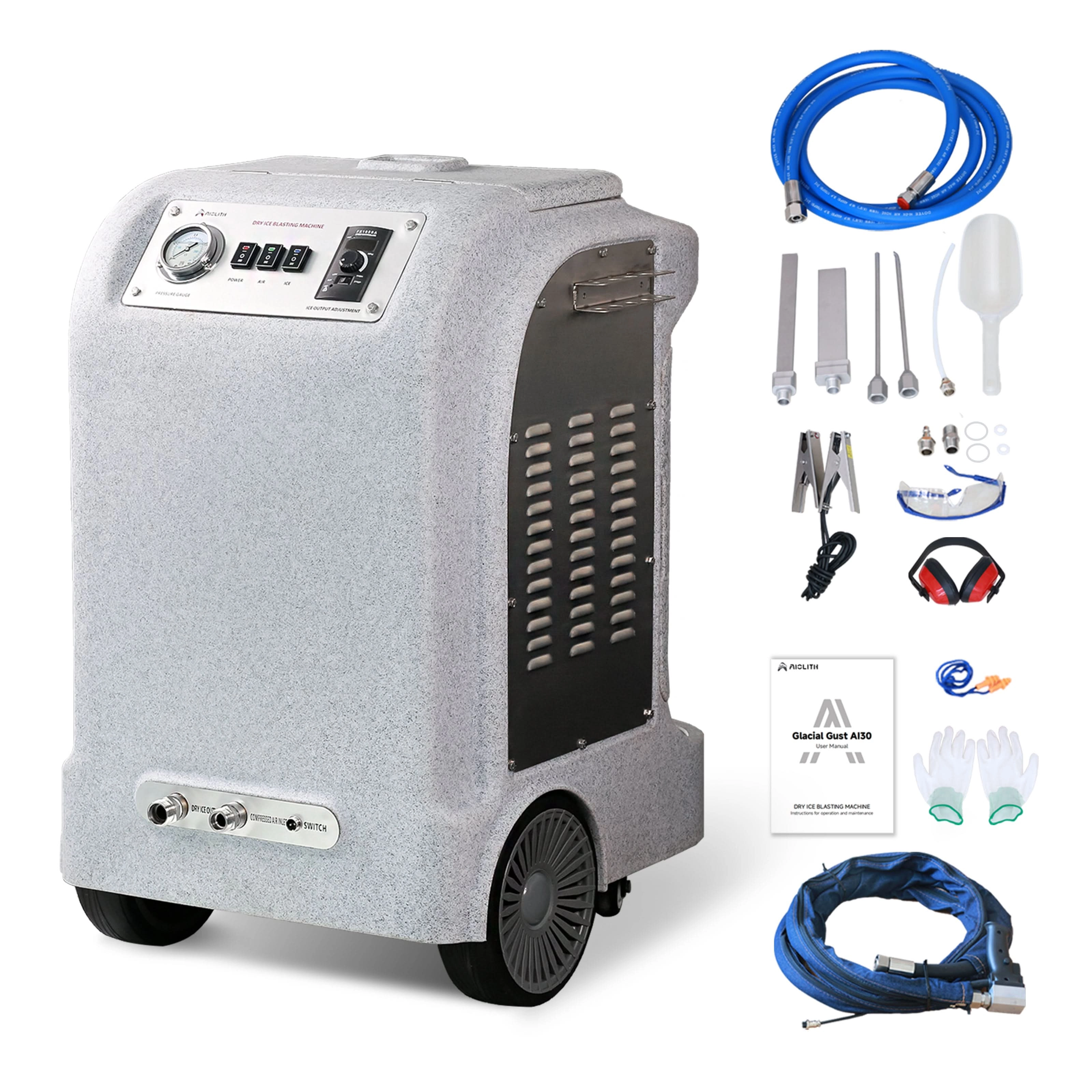
The Aiolith Ai30 represents a new generation of American-engineered equipment.
It targets medium-duty industrial cleaning precisely.
Instead of oversizing capacity, Ai30 focuses on usable performance.
As a result, we see better cost efficiency.
This balance makes Ai30 attractive for manufacturers upgrading from traditional methods.
Aiolith Ai30 Technical Specifications
| Parameter | Specification |
|---|---|
| Voltage/Frequency | 110V / 60Hz |
| Dry Ice Hopper | 44 lbs (20 kg) |
| Dry Ice Output | 0.66–1.32 lb/min |
| Air Pressure Input | 87–116 PSI (Adjustable) |
| Air Flow Input | 71–141 CFM |
| Ice Diameter | ≤3 mm |
| Dimensions | 28 × 24 × 37 inches |
| Weight | 135 lbs (61 kg) |
| Recommended Compressor | ≥7.5KW, ≥150 gal |
These specifications support precision cleaning without unnecessary complexity.
Why Aiolith Ai30 Delivers Exceptional Cost Performance
We often evaluate equipment based on total usability.
Ai30 performs strongly in several key areas.
First, adjustable ice output allows precise control.
Therefore, operators avoid excessive dry ice consumption.
Second, compact dimensions improve mobility across production lines.
Third, power requirements align with standard industrial electrical setups.
For medium contamination levels, Ai30 outperforms expectations.
Typical Applications for a Dry Ice Cleaner Like Ai30
Ai30 suits a wide range of industries.
Common applications include:
- Mold and die cleaning
- Conveyor belt maintenance
- Electrical cabinet cleaning
- Food processing equipment sanitation
- Automotive component restoration
Each application benefits from non-abrasive impact.
Therefore, surface damage risks remain minimal.
Understanding Total Cost of Ownership Before Investing
Purchase price never tells the full story.
Operating costs, maintenance, and downtime matter more.
We recommend using this professional calculator to evaluate ROI:
👉 Dry Ice Blasting TCO Calculator
According to Deloitte, predictive maintenance strategies reduce downtime by 30%.
Dry ice cleaning integrates perfectly into these strategies.
Environmental and Regulatory Advantages of Dry Ice Cleaning
Dry ice is reclaimed CO₂.
It sublimates directly into gas.
Therefore, no secondary waste exists.
OSHA reports indicate lower exposure incidents in non-chemical cleaning environments.
This benefit simplifies compliance across regulated industries.
Maintenance Expectations for a Dry Ice Cleaner System
Routine maintenance remains straightforward.
We recommend inspecting hoses regularly.
Dry ice quality should remain consistent.
Compressors require scheduled servicing.
However, overall maintenance costs stay low.
Dry Ice Cleaner vs Traditional Cleaning Methods
| Factor | Dry Ice Cleaner | Chemical Cleaning |
|---|---|---|
| Secondary Waste | None | High |
| Equipment Damage | None | Possible |
| Downtime | Low | High |
| Environmental Impact | Minimal | Significant |
This comparison highlights why adoption continues accelerating.
Dry Ice Cleaner Buying Checklist
We recommend confirming the following before purchase:
- Cleaning frequency
- Contamination severity
- Compressor compatibility
- Energy availability
- ROI expectations
This structured approach prevents costly mismatches.
Frequently Asked Questions
1.Is a dry ice cleaner safe for electrical equipment?
Yes. Dry ice cleaning uses no moisture.
2.Does Aiolith Ai30 require a dedicated compressor?
Yes. It requires an industrial compressor meeting airflow specifications.
3.Which industries benefit most from dry ice cleaning?
Food, automotive, aerospace, electronics, and manufacturing industries benefit significantly.
4.Is dry ice cleaning environmentally responsible?
Yes. It produces no secondary waste and reduces chemical usage.
5.How long does dry ice last during operation?
Dry ice sublimates quickly. Proper planning ensures uninterrupted cleaning.
Final Perspective on Investing in a Dry Ice Cleaner
We see industrial cleaning entering a new era. A dry ice cleaner delivers efficiency, safety, and sustainability. Aiolith Ai30 stands out for medium-duty requirements.
When paired with the right compressor, performance remains consistent. Smart investment decisions now create long-term operational advantages.
References
MarketsandMarkets – Industrial Cleaning Equipment Market Report, 2024
https://www.marketsandmarkets.com/Market-Reports/industrial-cleaning-market-30881069.html
U.S. Environmental Protection Agency – Hazardous Waste Cost Trends, 2022
https://www.epa.gov/hwgenerators/hazardous-waste-generator-regulatory-summary
Deloitte Insights – Predictive Maintenance Statistics, 2023
https://www2.deloitte.com/us/en/insights/focus/industry-4-0/predictive-maintenance.html
OSHA – Workplace Safety and Cleaning Standards, 2023
https://www.osha.gov/laws-regs/regulations/standardnumber/1910